Protein, Politics, and the Food Pyramid: What the New U.S. Nutrition Guidelines Actually Mean for High-Performing Professionals


The latest federal nutrition update corrects some long-standing mistakes—but still stops short of telling busy professionals what they really need to know.
Nutrition Guidelines Are Not the Same Thing as Nutrition Strategy
Every few years, the U.S. government releases updated nutrition guidelines, and every time we collectively pretend they’re either gospel or garbage.
They’re neither.
The most recent update, released during the Trump administration, is no exception. It makes some meaningful course corrections, avoids others entirely, and leaves large interpretive gaps that professionals are expected to magically fill in on their own.
That’s a problem if:
- You work long hours
- You make high-stakes decisions
- You don’t have time to “intuitively eat” between conference calls
So let’s talk about what actually changed, what didn’t, and how to use this guidance without outsourcing your health to a federal committee.
The Big Picture Shift (Before We Argue About Macros)
For decades, U.S. nutrition guidance leaned heavily on:
- Grain-first eating
- Low-fat everything
- Calories as the primary unit of concern
- Processed foods treated as neutral if “fortified”
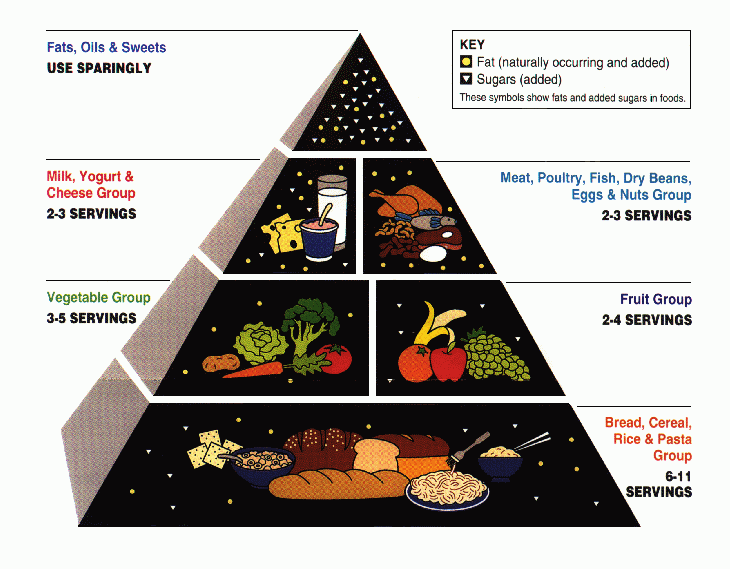
The longstanding emphasis on low-fat diets was fundamentally flawed, a myth that was debunked decades ago by the fitness community. Foods marketed as-fat were often replaced with higher amounts of sugar, which failed to promote satiety and instead contributed to sluggishness and weight gain. While whole grains are not inherently harmful and can be part of a balanced diet, they are not necessarily conducive to peak productivity; after consuming a sandwich, pasta, or rice, many individuals feel sleepy or bloated—an effect that is no coincidence. These dry carbohydrates tend to slow down digestion and create discomfort. When aiming to shed a few pounds, I recommend reducing these dry carbs rather than eliminating all carbs altogether. The most beneficial sources of carbohydrates are juicy, nutrient-dense options like fruits and vegetables—precisely what the new dietary guidance now advocates—because they provide energy without the sluggish aftereffects.
I don’t want no scrubby carbs, says Trump administration
The new guidance quietly walks some of that back. Not loudly. Not perfectly. But noticeably.
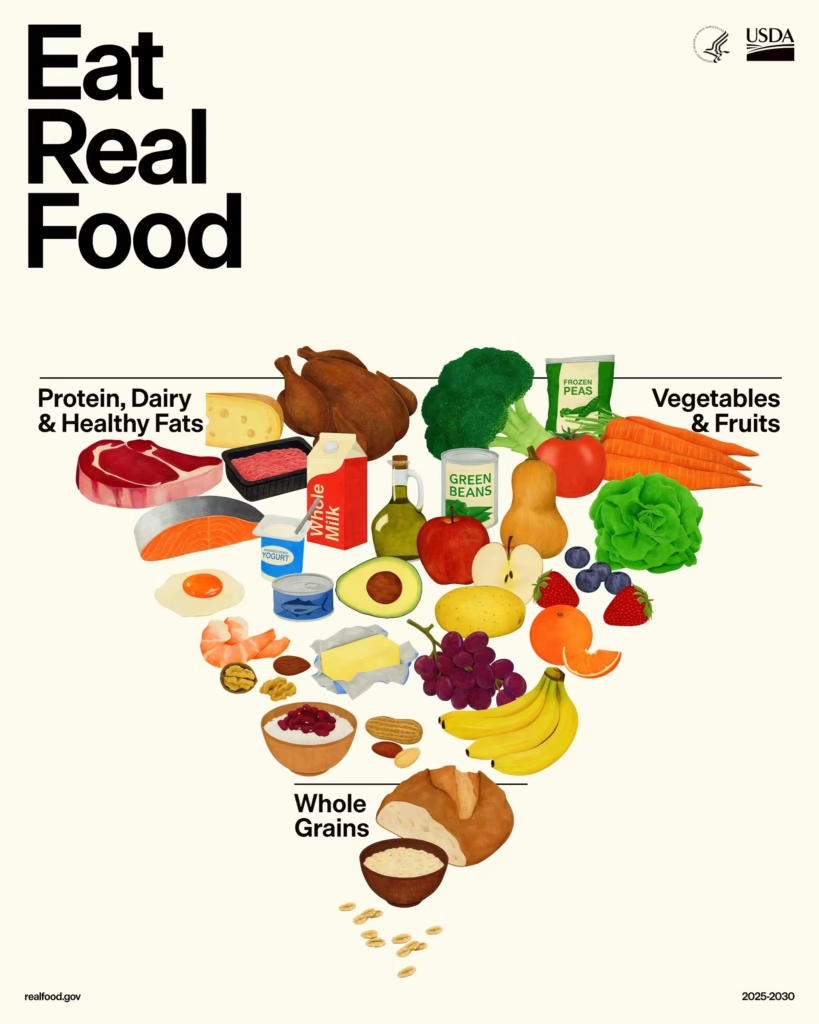
This matters because frameworks shape behavior—even when they’re vague.
What the Guidelines Say About Protein (And What They Avoid Saying)
Let’s get specific, because protein is where the internet goes feral.
What the Guidelines Still Rely On
The baseline reference point remains close to 0.8 grams of protein per kilogram of body weight per day, which historically evolved from earlier benchmarks closer to 0.75 g/kg/day.
This number has always been a minimum to prevent deficiency, not an optimal intake for:
- Active adults
- Aging populations
- High-stress professionals
- People trying to preserve lean mass while working 60-hour weeks
What’s New (and Actually Interesting)
The updated guidance:
- Places protein more centrally in recommended food patterns
- Explicitly encourages higher-quality protein sources
- Stops framing protein as something that crowds out “better” foods
What it still does not do:
- Set optimal intake ranges
- Address protein needs under cognitive or occupational stress
- Differentiate sedentary from high-performance lifestyles
This is where DAOFitLife steps in.
In The DAO Approach to Food, protein is not a macro—it’s a decision stabilizer.
👉 https://daofitlife.com/tools/the-dao-approach-to-food/
Macro Targets: What Exists, What’s Missing, and Why That’s a Problem
Here’s a clear side-by-side of what professionals are actually being told.
Macronutrient Guidance Comparison
| Macronutrient | Prior Guidance | Updated Guidance | What’s Still Missing |
|---|---|---|---|
| Protein | Minimum-based, secondary | Elevated in food patterns | No performance-based ranges |
| Fat | Low-fat preferred | Full-fat dairy permitted | No clarity on fat sufficiency |
| Carbs | Grain-centric | Whole-food emphasis | No insulin context |
| Sugar | “Limit intake” | Explicit discouragement | No cognitive impact discussion |
| Processing | Minimally addressed | Ultra-processed discouraged | No enforcement or definition clarity |
Translation: better framing, same ambiguity.
Full-Fat Dairy: The Quietest, Smartest Correction
One of the least controversial—and most overdue—changes is the removal of the automatic preference for low-fat dairy.
This matters because low-fat products:
- Are often more processed
- Contain added sugars or stabilizers
- Provide less satiety
The guidelines stop short of explaining why this change matters, which leaves many consumers confused. But it aligns with metabolic reality and the DAOFitLife position: food quality beats fat phobia.
Added Sugar & Ultra-Processed Foods: Finally Named, Still Under-Explained
The explicit discouragement of ultra-processed foods is welcome—but incomplete.
What’s missing is the discussion of neurological and behavioral consequences, which is where policy guidance tends to go silent.
This is the focus of Your Brain on Lab-Grown Food:
👉 https://daofitlife.com/tools/your-brain-on-lab-grown-food/
Calories don’t make decisions. Brains do.
And brains respond very differently to engineered inputs than to whole foods—especially under stress.
Keto, Low-Carb, and the Guidelines’ Strategic Silence
The updated framework neither endorses nor condemns ketogenic or low-carb approaches. But it appears to be trending the food prioritization back in that direction. With more emphasis on full fat dairy products and protein, and less on whole grains this is very keto adjacent.
That neutrality is intentional—and defensible—but incomplete.
As explained in Executive Summary of the Keto Diet:
👉 https://daofitlife.com/path/act/executive-summary-of-the-keto-diet/
Keto is not a lifestyle mandate. It is a metabolic lever. Federal guidelines are not built to discuss levers; they are built to describe averages.
Professionals don’t live at the average.
Comparison Table: Old vs New Food Pyramid Logic
Conceptual Food Pyramid Shift
| Layer | Old Pyramid Logic | New Pyramid Logic |
|---|---|---|
| Base | Grains & starches | Protein + whole foods |
| Middle | Low-fat dairy | Full-fat dairy allowed |
| Top | Fats & sugars | Added sugars discouraged |
| Processing | Neutral | Explicitly discouraged |
| Flexibility | Low | Slightly increased |
The DAOFitLife Takeaway
These guidelines are not a failure.
They are also not a solution.
They represent institutional course correction, not optimization.
For busy professionals, the move is not compliance—it’s interpretation:
- Use protein as infrastructure
- Choose whole foods over engineered ones
- Treat sugar and processing as cognitive risks, not indulgences
- Apply frameworks, not food rules
Smarter decisions. Stronger humans.
CTA
If you want nutrition guidance designed for real workdays:
- Business Class Fitness (Book): https://daofitlife.com/books/business-class-fitness
- DAOFitLife Jump Start Guide: https://daofitlife.com/download/the-daofitlife-jump-start-guide/
- DAOFitLife Newsletter: https://www.linkedin.com/build-relation/newsletter-follow?entityUrn=7347969352001830912