You do not need another complicated food tracking app to get healthier. You need a system that fits naturally into real life.
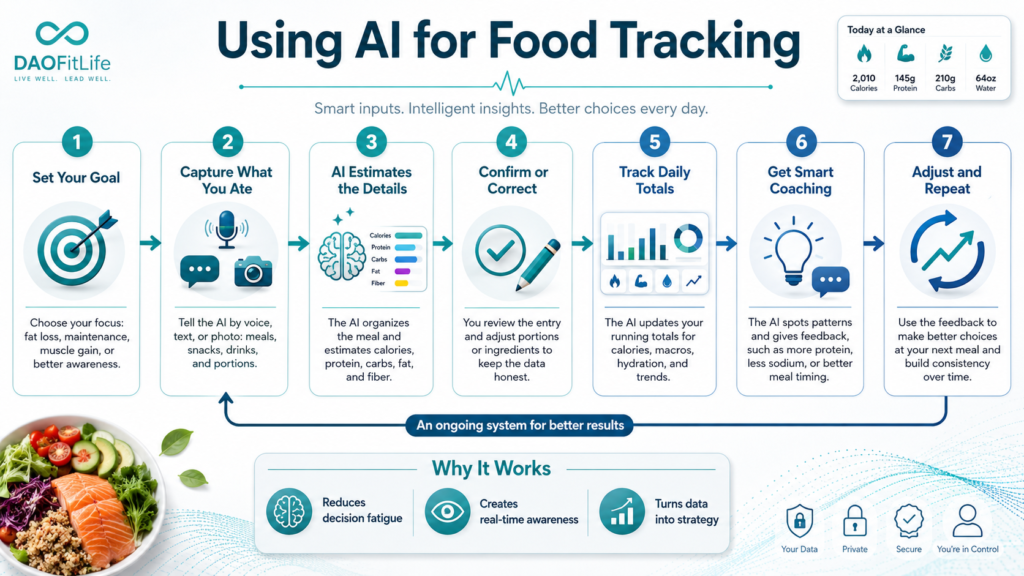
Lately, I’ve been using AI Food tracking, weight management, and exercise logging—and it has completely changed the way I approach consistency because it feels less like “tracking” and more like having a real-time nutrition coach in my pocket.
I’ve also trained it on the entire DAOFitLife philosophy—my nutrition frameworks, wellness principles, tracking methods, and approach to sustainable body architecture—so the guidance feels personalized to the way I actually live, eat, and work.
Foundations: Before We Talk Tech
Before we talk about AI, calorie estimation, or food logging workflows, we need to talk about philosophy.
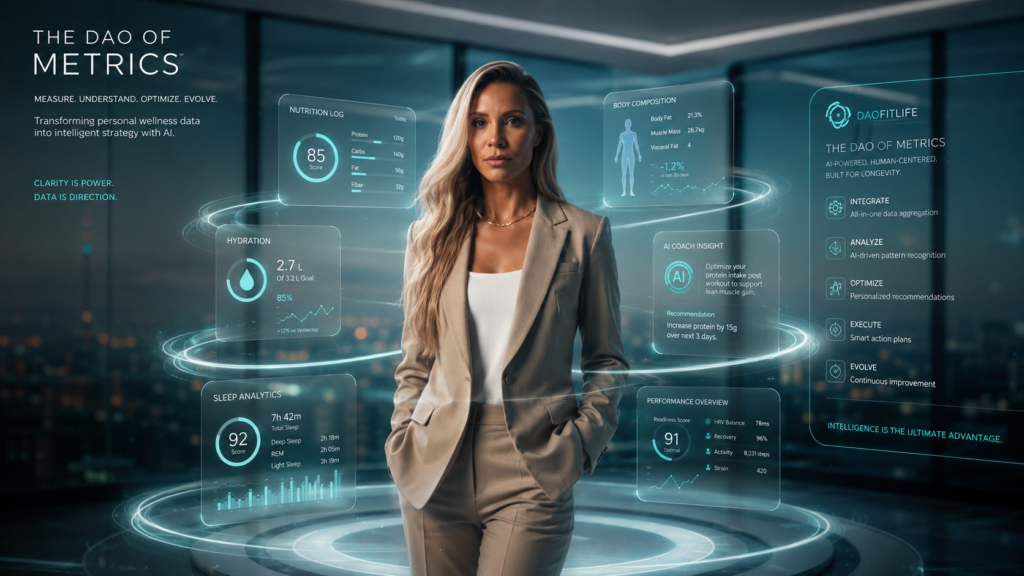
One of the foundational concepts behind DAOFitLife is what I call The DAO of Metrics: the belief that measurement creates clarity. The full framework lives here:
The DAO of Metrics: Why Numbers Are Your Only Real Friends
That article explains one of the core truths that shaped both my professional and wellness life:
You cannot manage what you do not measure.
In my legal career, I would never walk into a negotiation without documentation, data, or financial analysis. Yet people routinely approach their health completely blind and then wonder why they feel stuck.
In my book Business Class Fitness, I dedicated an entire chapter to food logging because logging is not about punishment or restriction. It is about awareness.
Without metrics, you are operating on feelings.
And feelings are unreliable.
The scale lies temporarily. Hunger lies. Memory lies. Emotions lie.
Data tells the truth.
The Commandment: If It’s Not Effortless, You Won’t Do It

One of the “50 Commandments” in my upcoming framework is this:
If it’s not effortless, you won’t do it.
That does not mean accuracy does not matter.
It absolutely matters.
You still need honesty.
You still need portions.
You still need accountability.
What it means is that the process of collecting the data cannot become so exhausting that you abandon it altogether.
And that is exactly where AI changed everything for me.
Why Google Gemini Works Better Than Traditional Tracking Apps

Traditional food apps often feel mechanical:
- search the database,
- select the item,
- estimate the serving,
- click through menus,
- repeat endlessly.
For busy professionals, that level of friction becomes unsustainable.
What I realized is that I did not actually need a better database.
I needed a better interface.
Now I simply voice dictate my intake to Gemini in real time—as if I were texting or talking to a live nutrition coach throughout the day.
That distinction matters.
I am still tracking accurately.
I am still being accountable.
I am still measuring.
But instead of interrupting my life to manually enter everything into a rigid app, I can naturally narrate my day as it happens.
AI Food Tracking Understands Real Human Eating

This is where conversational AI becomes incredibly powerful.
Human eating is nuanced.
Traditional apps struggle with nuance.
AI doesn’t.
For example, I can say:
“My husband and I split the pasta but I ate about 40%.”
Or:
“I had some cheese but gave about a third of it to my dog.”
Or:
“We shared appetizers across the table and I mostly ate the tuna.”
Gemini can reason through proportional intake in seconds.
That removes one of the biggest psychological barriers to tracking:
the feeling that everything has to be mathematically perfect to count.
You are still striving for honest data.
You are still estimating thoughtfully.
But AI helps bridge the gap between real life and rigid tracking systems.
And honestly, that is how actual humans eat.
The Shift From “Logging” to Continuous Awareness through AI Food Tracking

The biggest breakthrough for me was realizing that tracking does not need to feel like accounting software.
It can feel conversational.
Throughout the day, I’ll casually update Gemini:
- “Protein yogurt and berries for breakfast.”
- “Took a walk at lunch.”
- “Salmon salad with olive oil dressing.”
- “Weight this morning was 126.8.”
Then at night I ask:
“Can you summarize my day?”
And I get:
- estimated calories,
- protein intake,
- activity level,
- observations,
- patterns,
- and feedback.
Not in a shame-based way.
In a strategic way.
When I shifted my process to Gemini, I stopped “logging” and started conversing. Throughout the day, I casually update my AI as if I’m speaking to a Chief of Staff.
By the end of the day, I don’t just get a list of numbers. I get a Forensic Audit.
The Shift to Forensic Metabolic Auditing

For years, the gold standard of fitness was “logging.” We used apps like MyFitnessPal or Noom, which essentially act as digital accounting software. You scan a barcode, it records a number, and if you go over your limit, it turns red.
It’s manual, it’s tedious, and frankly, it’s shame-based.
The biggest breakthrough for me was realizing that tracking shouldn’t feel like balancing a checkbook. It should feel like a high-level executive briefing.
Why AI Beats the “Legacy” Apps
Popular food apps are passive databases. They don’t have a memory, and they don’t have “eyes.” Here is how a trained AI (The Metabolic Architect) outperforms them:
| Feature | Legacy Apps (MyFitnessPal/Noom) | The AI Forensic Audit (Gemini) |
|---|---|---|
| Context Memory | Treats every day as a blank slate. | Remembers I had honey yesterday but skipped it today; notes the “purity” shift. |
| Logic Application | Uses a static, rigid database. | Applies the “Buffer Clause” (10% Galaxy Tax) to account for hidden oils. |
| Forensic Troubleshooting | If weight is up, it just shows a red line. | Detects “Corrupt Data” (edema from a massage or the “Sponge Effect” of fiber). |
| Sensory Feedback | Zero awareness of physical state. | Remembers any negative reaction to certain foods and suggests a pivot. |
| Strategy | Tells you what you did. | Tells you what to do (e.g., “Execute a Pressure Flush due to high sodium”). |
Limitations of picture-based and direct-input tracking
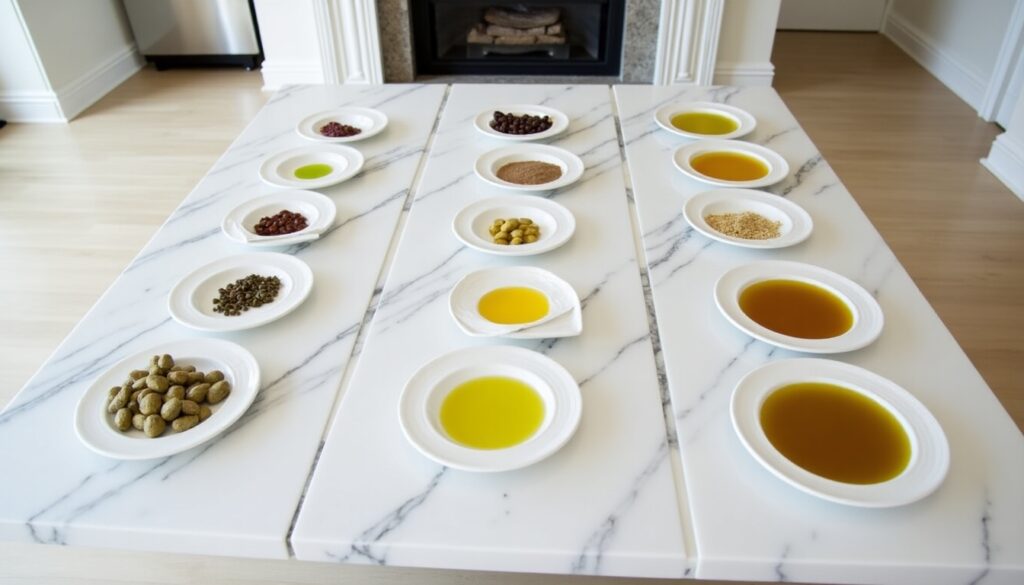
Apps that rely photos or straightforward entries often fail to account for added oils, dressings, and condiments, which can substantially inflate daily calories. with accurate images portion size and dispersion of these ingredientsfrequently the largest hidden contributors—may go underreported turning otherwise modest meals intoic surges.
The Executive Dashboard
At the conclusion of the day, the objective is not to receive a “grade” or a subjective performance review. Instead, the goal is to review an Executive Dashboard for Metabolic Performance.
In a corporate environment, leadership does not scrutinize every individual line item to determine a path forward; rather, they leverage high-level briefings and strategic summaries to evaluate trajectory and momentum. This is the precise function of the AI: it serves as a Chief of Staff, distilling raw daily metrics into a Strategic Briefing.
By managing personal health data with the same rigor as a corporate ledger, you decouple your progress from emotional volatility. This transition from “judgment” to “analytics” provides the objective clarity necessary to lead yourself toward high-stakes physical and mental goals with professional precision.
Why AI Food Tracking Works Psychologically

Most people fail wellness systems because the system itself creates exhaustion.
The hidden problem is not laziness.
It is cognitive overload.
Every tiny decision drains energy:
- opening the app,
- finding the food,
- estimating servings,
- remembering forgotten snacks,
- correcting entries later.
By reducing friction, AI allows consistency to survive real life.
And consistency is the entire game.
The Real Power of AI Food Tracking: Memory + Personalization
Over time, Gemini starts learning my actual habits:
- my usual breakfasts,
- my preferred protein bars,
- my salad dressings,
- my recurring meals,
- my restaurant tendencies,
- my exercise patterns.
So the process gets faster and more intelligent over time.
It becomes personalized metabolic infrastructure.
Not generic dieting.
The DAO of Metrics in Practice
People often misunderstand tracking.
They think tracking is obsession.
I think tracking is awareness.
There is a massive difference.
When you track:
- you notice patterns,
- you understand fluctuations,
- you stop catastrophizing normal changes,
- and you make calmer decisions.
You stop reacting emotionally to one meal or one weigh-in.
You start thinking like an architect.
That is the real philosophy behind the DAO of Metrics.
Not punishment.
Not perfection.
Not restriction.
Clarity.
The Future of Wellness Is Intelligent Infrastructure
I genuinely believe the future of wellness is not:
- stricter dieting,
- more complicated apps,
- or endless willpower.
It is intelligent systems that reduce friction while increasing awareness.
Systems that:
- personalize,
- adapt,
- synthesize,
- remember,
- and help humans make better decisions without consuming their entire lives.
That is why I love using Google Gemini for this process.
It does not replace discipline.
It supports consistency.
And consistency is what changes bodies.
Final Thought
The best tracking system is not the one with the prettiest interface.
It is the one you will actually use:
- when work gets chaotic,
- when you travel,
- when you are tired,
- and when motivation disappears.
That is why effortless matters.
Because sustainable systems always outperform temporary intensity.
The DAO of Metrics was never about becoming obsessed with numbers.
It was about using numbers to become more honest with yourself.
And now, AI makes that process more natural than ever.
Smarter Tech. Stronger Humans.
DAOFitLife may earn commissions from affiliate links on this page.